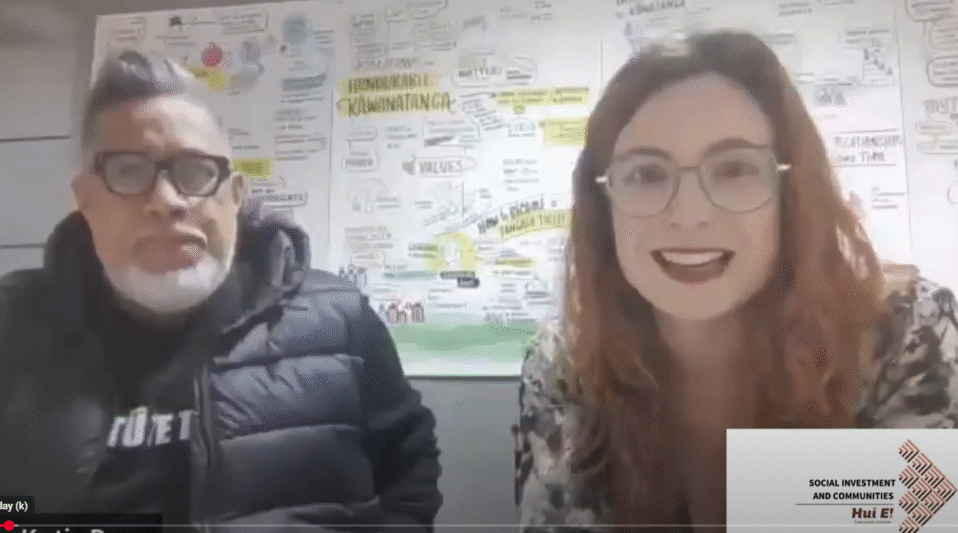
On 15 August 2025, Hui E! hosted the Social Investment Agency for a deeper dive into social investment from a community perspective, on behalf of the Community Constellation.
The kōrero was led by the ideas, examples and questions that you sent through on registration, and facilitated by Katie Bruce, Kaiwhakahaere Matua | Chief Executive of Hui E! Community Aotearoa and Atawhai Tibble, Kaihautu at Barnardos Aotearoa, whose experience spans national policy, global wellbeing measurement, and community-led initiatives. Atawhai and Katie were joined by Joe Fowler, Deputy Chief Executive Investment and Commissioning, from the Social Investment Agency (SIA) who shared information about the new Social Investment Fund and its priorities and discussed all things community impact with Katie and Atawhai.
Please view and share the video below.
We were left with 40 questions for the Social Investment Agency from participants. See below for answers provided by the Social Investment Agency.
Social Investment Agency response to follow-up questions (received 25 August 2025):
- Questions about the application processes
These questions covered:
- the types of organisations and projects that could be covered by the Social Investment Fund
- the application criteria and required information for potential applicants and whether a programme or service which has lost its funding will be considered as a New Investment.
- how many organisations will receive funding
- why SIA needs to test the approach with organisations and whether the outcome plans can include changes to the social structures and circumstances as well as change for the individual/whanau.
There are four pathways within the Social Investment Fund (SIF). These are:
- New Investments. Opening 25 August 2025.
- Contract Consolidation. Opening 01 September 2025.
- Community Commissioning. In development.
- Co-investment. In development.
Details about the application process for the first two pathways can be found on the SIA website https://www.sia.govt.nz/social-investment-fund/pathway-one-new-investment-round-one
Further information about the remaining two pathways will be published later in 2025. All organisations who are registered as a legal entity in New Zealand, have at least one level of Te Kahūi Kahū accreditation, and meet the requirements of the funding pathway are eligible to apply.
The New Investments pathway will consider applications covering programmes and services which have previously been delivered but are not currently funded.
In 2025 and early 2026, the Social Investment Fund will primarily make new investments in organisations that have the infrastructure and capacity to help us test and scale the social investment approach at pace. This work will pave the way for changes that will benefit the wider social sector.
The agreements that SIA enters into with organisations will be outcomes-based and centred on the organisation’s theory of change. The agreements will allow for learning and adaptation to this theory of change including changes to how initiatives are delivered. This will be agreed with organisations as part of jointly confirming the outcomes-based agreement.
The exact number of organisations funded in this round will depend on the proposals received. The Fund expects to have at least 20 initiatives in place by June 2026.
- Questions about the priority population groups
These questions asked about:
- whether SIA would be releasing more data around the cohort and regions as to where support is needed
- if the second pathway consolidation would have the same sort of priorities as the demonstration initiatives or a wider set of priorities
- the responsibilities of the organisations to identify where the need is.
SIA has released more information about the priority populations as part of the opening of the Social Investment Fund on 25 August 2025. This includes data about the number and geographic location of people identified as being part of one of the priority populations.
For each round of the Social Investment Fund, a group of Social Investment Ministers will make decisions on the priority population groups.
The Contract Consolidation pathway does not have specified priority cohorts. Organisations interested in contract consolidation will need to outline who they are working with; however, SIA expects these will be different to those identified as a priority for New Investments Round One.
- Evaluation processes
These questions covered the evaluation processes and practices including whānau metrics of success, values or principles underpinning initiative delivery and comparison to international evaluation models.
The Social Investment Fund will work with organisations it funds on a jointly agreed evaluation plan. This means that ‘evaluability’ and a shared learning approach will be built into the initiative from the start.
To support elements of the evaluation, the Social Investment Fund will rely on funded organisations providing data to Statistics New Zealand’s Integrated Data Infrastructure (IDI). The data will be used to support the evaluation and help funded organisations understand more about the people they are reaching. SIA has produced a quick guide which sets out the information that will be required to support this component of the evaluation.
Social Investment Fund Ministers have agreed a set of outcomes and measures for the first round of the New Investment pathway, and the evaluation plan will reflect how funded organisations are supporting individuals in ways that lead to changes in these outcomes.
SIA recognises that organisations it works with will often have their own outcomes frameworks and ways of defining success, as will the people and families receiving support. It also recognises that government administrative measures are often ‘deficit-focused’.
SIA’s outcomes-based agreements and jointly agreed evaluation plans will therefore allow organisations to define and focus on the goals and outcomes they include within their own theory of change. This will ensure, for example, that whānau metrics of success, values or principles are reflected in the evaluation plan.
- Access to funding for smaller organisations
Questions were asked about:
- evaluation data and as it applies to small and large organisations and whether it takes into account the organisation’s size of delivery, its staff numbers and its turnover.
- ensuring SIA works with organisations who are in the community and closest to the work and about organisations that may be keen but not have the resources or capability required.
The arrangements required for the social investment approach are genuinely different. They typically rely on data-sharing agreements with Statistics NZ; robust organisational privacy policies; secure data infrastructure; and outcome-based agreements centred around a clear ‘theory of change’. All of this enables robust evaluation and a high-trust partnership model.
The evaluation plan that forms an integral part of the approach also relies on organisations reaching enough people to support the evaluation of outcomes using Government-collected data. This is especially important early on as SIA is aiming for evaluation standards that are very rarely reached for social services.
Testing this new approach is not easy. The organisations SIA will invest in initially need the infrastructure and capacity to partner and learn with us. They will also need to support enough people in the community to enable a robust evaluation. It’s a lot to ask.
None of the above means that smaller organisations will be excluded from the social investment approach. There will also be more opportunities for smaller organisations to be involved in the other commissioning pathways.
- Data and infrastructure
These questions covered:
- providing a consistent approach to data collection and data/AI sovereignty
- consideration of relevant previous evaluations
- not to take a short-term approach.
The Social Investment Fund will work with organisations it funds in the next year on a jointly agreed evaluation plan. The evaluation plan relies on funded organisations providing data to Stat’s NZ’s IDI.
The data will be used to support the evaluation and help organisations understand more about the people they are reaching.
SIA is asking for the minimum data needed to enable this linking. This is outlined below:
Personal identifier(s):
If you’re already collecting and using a government unique identifier: We work together to determine the minimum data needed, which typically includes the date service started, the date service ended, and the unique identifier.
If you’re not collecting a government unique identifier: We work together to determine the minimum data needed, which typically includes the date service started, the date service ended, full name, date of birth, and address.
Start date: The date the individual began working with your organisation.
Exit date: The date the individual ceased working with your organisation.
Data will be shared directly with Stats NZ, with the process for this governed by a Data Sharing Agreement.
SIA staff will not be able to see any personally identifiable information about the people organisations are working with and will only receive de-identified and aggregated data back from Stats NZ.
Data in the IDI is governed by two frameworks, one of which is Stats NZ’s Ngā Tikanga Paihere. There are strict privacy and data protection processes in policy which all organisations will be required to follow.
SIA recognises that data is only one part of the picture, and that context, knowledge of organisations and communities, storytelling, and lived experience are key parts of the overall picture. It’s for that reason that SIA will provide the same data it uses back to organisations to use themselves, and work with funded organisations on how they bring together all the different sources of data to understand the impact of services in a way which understands the cultural and local context.
SIA recognises that individual data sharing is not appropriate for some services. SIA will not ask, nor expect social service or community organisations to do anything that compromises their safety or the safety of the people they support.
6. Te Ao Māori approaches
These questions covered:
- agreements with Māori organisations and those delivering services to Māori
- who would be on the panel to help SIA gain an understanding of Te Ao Māori perspectives, so they understand how their methods of change work.
Response re iwi and/or Māori organisations
SIA has heard from both iwi partners and those within the sector, including Māori organisations who are interested in the Fund. To date, SIA has engaged with iwi and Māori organisations where there has been interest across one or more of the pathways. This will continue irrespective of the round-based structure of Pathways One and Two.
Panel
SIA intends to form a panel that understands the breadth of the social and community sector. Accordingly, the make-up of the panel will be representative of this, and this will include iwi/Māori members.
- Community commissioning and working with the philanthropic sector
These questions covered how community commissioning would work including the forms of decision-making, the decision-makers and potential training of local leaders who may have no experience of social commissioning.
Community commissioning is a model where decision-making authority for social service investment is led by local leaders, empowering communities to tailor solutions to their specific needs.
SIA is currently undertaking exploratory policy, legal, and design work to develop options for how community commissioning could work. It will engage with philanthropic organisations, iwi, and local collectives about the potential for community commissioning as part of this process.
SIA will be providing advice to Ministers on community commissioning over the next 5 months.